WORCESTER CATHEDRAL VISIT – 8TH JUNE 2011
On Wednesday 8th June 22 of us visited Worcester Cathedral for a fascinating morning looking at how rocks were and are used in this great building. First we spent one and a half hours with Darren Steele the Manager of the Stone Masons’ Yard. Then after coffee in an 11th century location, i.e. the Chapter House, we moved on to see the remains of monastic life here through the expertise of Chris Guy the cathedral’s archaeologist.
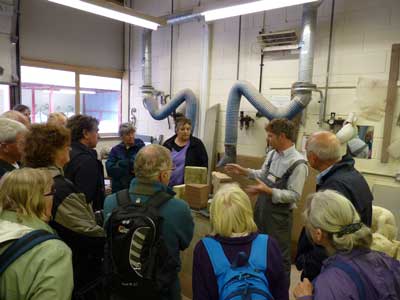
Darren Steele in the stone masons’ yard
Darren’s enthusiasm was infectious, with his concern for the creative development of his team of 8 masons [including 2 women] shining through. Worcester is one of 8 cathedrals with a similar masonry setup and collectively they are sharing each other’s expertise in particular skills. Apart from a massive diamond tipped saw to initially shape blocks of stones, the subsequent hand work is all down to methods and with tools recognisable from centuries ago. [ E.g. see the stained glass window in the Cloisters of a Victorian mason at work]
Stone sourcing is very significant – the prime aim being to match as far as possible the original stone in areas under repair or replacement. Evidence of this abounds as do past examples of where this had not been the policy. He illustrated with 2 particular examples. One was the very recent work to replace a tracery window in the ruined end wall of the Guesten Hall, where a robust St. Bees red sandstone has been used.
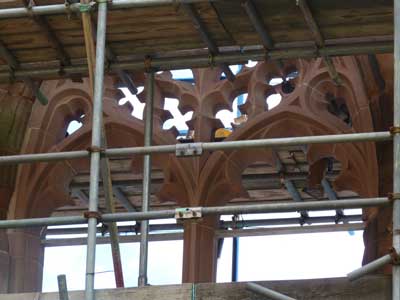
The new tracery window in place
Then secondly in the cloisters [when viewed from the internal garden], extensive work has gone into renewing the parapets using new mottled green Hoddington freestone mixed with the best of the original blocks. Work has also just started to replace the 24 intricately carved pinnacles, which were taken down in the 1930s because of internal metal corrosion.
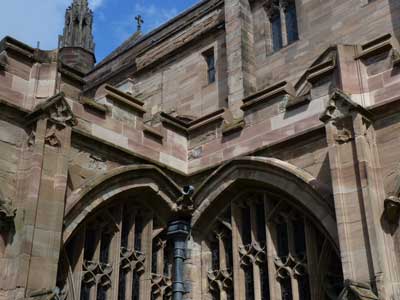
Restoration of parapet above cloisters

First replacement pinnacle above cloisters
Lime based mortar is used throughout, which allows the main tower to sway 6 inches when the bell ringers get busy!
Chris joined us in the Chapter House and opened our eyes to its features e.g. the Purbeck marble window shafts. He described the building’s use – the ‘Chapter’ reference coming from the Benedictine Monks meeting daily to read one chapter of the Order’s Rules. Recent work to replace the wooden floor led to the discovery of 180 Anglo Saxon burials.

With Chris Guy in the Chapter House
The existing café is in what was originally a passageway and the arches within its walls probably are recycled from the remains of an Anglo Saxon building. The wall to the left of the café has an area of neat ashlar blocks [with a tiny window looking out from an old turret staircase], and beyond is an area of rough sandstone which probably was originally plastered and then painted over with a stone pattern.
Standing in College Green we looked at the outside of the Monks’ Refectory now the Kings School Hall. Much of the stone work now to be seen is from C18th and C19th restoration. The archway back into the cloisters is also worth closer study being C12th – again Purbeck marble features.
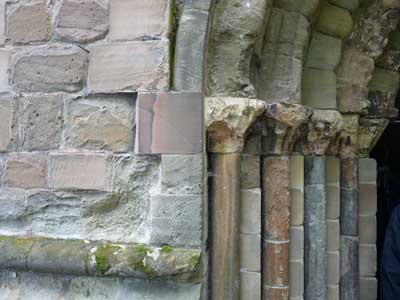
Details of original doorway from College Green into cloisters
Returning to the south west corner of the cloisters, we saw the old doorway to the monks’ refectory and where those monks first washed their hands. Above us we admired the extensive C14th and C15th ceiling bosses carved from French Carn stone. On the west wall of the cloisters are the remains of various doors leading into the monks’ dormitory area. Apparently it is quite unusual to have the dormitory on the west side, but probably, as at Durham, this was so that the monks’ toilets could drain direct into the River Severn!
We next stood in a small walled garden on the site of the dormitory and could see the remains of the night door through which the monks would pass for their services during the night. Above were the traces of where 2 gable ends had abutted against the main cathedral. Having walked through the cathedral we emerged into the open area between the cathedral and the river to study the extensive C19th restoration work on the west end.
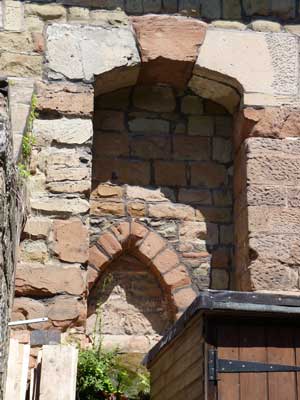
Remains of monks' night door from dormitory into church
Our last taste of monastic life was to see the 3 storey remains in red sandstone of where on the top floor the monks’ toilets had been. Flushing direct into the river is more obvious when you realise that until Diglis Lock and Weir were built in the 1840s the Severn was tidal this far up and the current bank with walkway did not exist.
So much to take in and plenty to spot with time and a keen eye. Do bear in mind too that the Earth Heritage Trust have a guided walk leaflet to follow around the inside of the cathedral looking at the stones used in the structure and for its many monuments. For details in the guided walk click here. Alternatively these can be purchased from Herefordshire and Worcestershire Earth Heritage Trust; Geological Records Centre; University of Worcester; Henwick Grove; Worcester WR2 6AJ (01905 855184) ; cost around £2. To see the write up and photos of the group's previous visit to the cathedral [which included following the self guided walk inside the building], click here.